The Trial of MARTY SUPREME

Marty Mauser is not a very good person. From the deeply insensitive jokes he causally employs in interviews to the sociopathic pursuit of his self proclaimed singular purpose, the cup of Marty’s sins would be sufficiently running over even if he didn’t abandon his pregnant girlfriend, Rachel, in a last ditch gasp for glory. Marty’s actions, all in the name of that lofty aspiration, are frequently despicable and a case might even be made that the platitudes espoused by Marty Mauser represent morsels of the very same grind mindset that echoes across today’s toxic manosphere right wing pipelines. Of course, Marty is hardly the first problematic male ever depicted on screen, yet perhaps his sins are more pressingly identified as the film never really, at least obviously, states that his actions are reprehensible, some even finding them praiseworthy. Yet, in a much discussed and debated moment at the close of the film, one that some have found as tacit support of his pride, a more fascinating central question emerges. Should a guilty fiend like Marty Mauser, especially if his film never condemns him, be allowed to cry? Or in other, broader, words, can the movies depict a misanthrope in the throes of euphoria and still be socially responsible in the morning? Some have said no, however, ultimately it is this very contradiction which elevates Josh Safdie and Timothee Chalamet’s Marty Supreme to another level, layering further its examination into capitalism, demonstrating a complexity of character and delivering, paradoxically, the brash as well as, where it conventionally typically would not be, the beautiful.
Context of a filmmaker’s past is key in initial analysis and when approaching the past work of the Safdie Brothers it would be a simple, even if still a reductive, conclusion to claim that following their fissure, much to the detriment of Benny, it is Marty Supreme director Josh Safdie who took most of the creative juice with him. It is true that Benny Safdie’s film The Smashing Machine features very little of the anxiety filled energy that defined their previous collaborative work, an energy contrastingly so clearly interwoven into Mary Supreme. It is further notable that both brothers released sports adjacent dramas featuring movie stars for their Uncut Gems follow-ups, making the two films even more ripe for comparison. However, on the outset it should be mentioned that Benny Safdie deserves more credit than is being afforded him for making leaps into uncharted territory for his own work. That film, featuring what may now be becoming even an underrated turn from Dwayne Johnson (words that maybe ought never to have been composed), is a soulful picture and while it is only partially successful in what it is clearly reaching for, it feels like the beginning of something that hopefully Benny continues running towards.
One of the most overlooked comparisons between the two films, is the ways both feature and to some level break down the masculinities of their characters. The Smashing Machine’s Mike Kerr, adapted in a much more straightforward fashion than Marty Supreme adapts its real life subject Marty Reisman, represents much of the masculine ideal. He is a hulking mass of flesh and muscle and thus when Benny and the Rock have him weep, it reads as unexpected and a semi-startling demonstration of vulnerability. Kerr’s actions, while certainly less manipulative than Mauser’s, are hardly always virtuous, compounded by his professional violence for a complexity of character which indeed makes an intriguing study into the intersections of masculinity, vulnerability and, bluntly stated, bad behavior. The subtext of capitalism is far more muted in Benny’s film, yet the way Kerr must harm his body for his own job security certainly plays into the overall consideration.
It is notable then, and likely the most obvious statement in this review, that Timothee Chalamet is nothing like Dwayne Johnson. Chalamet is clearly the more capable at their mutual vocation, and while he is certainly something of a sex icon for a group of people, even likely more than the Rock has ever enjoyed, it would be difficult to make a case that his Marty Mauser represents anything like the traditional masculine ideal, even as Marty embodies much of toxic masculinity throughout the film. This split between the form with which his behavior is presented and the behavior itself, creates another layer of subtext into the film’s considerations. This is not the adonis like figures of past cinematic luminaries, but a lanky twig of a man. This in and of itself neither excuses nor endorses any of his behaviors or actions, be they the crimes or the tears, yet it adds a significant layer into the overall texture of the study.
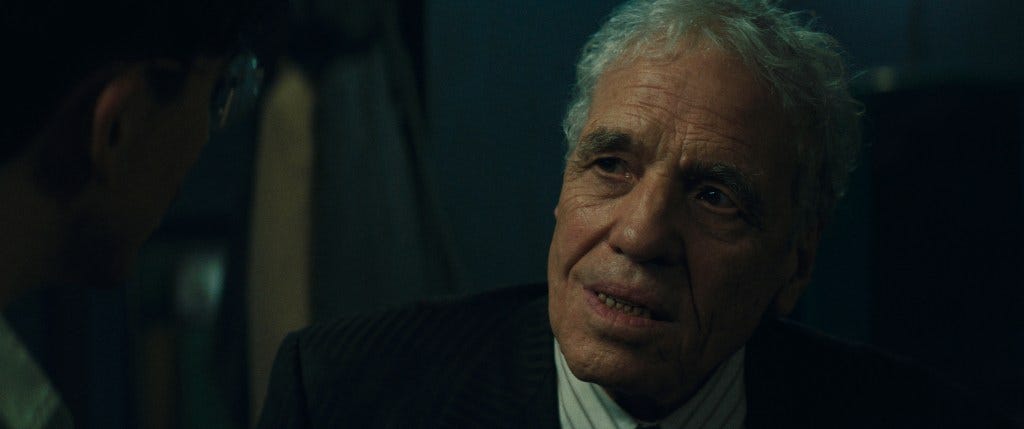
However, comparison only goes so far and with the due praise to his brother now afforded, it must be noted that on a sheer technical level what Josh Safdie has accomplished with Marty Supreme is staggering. While it may not exactly represent a true stylistic leap, (the film could even be considered a thematic trilogy closer, following 2019’s Uncut Gems and 2017’s Good Time), Marty Supreme represents a refinement and a further explosion of the chaotic energy that defined those past works, with much of their previous hallmarks repurposed and expanded upon here. Darius Khondji returns as cinematographer and the resulting images are rather glorious, beautiful compositions shot with long lensing, magnifying of course Marty’s personal anxieties, but adding another film to the 2025 canon of movies at last remembering the importance of the human face. This camera knows how to see into the souls of those upon which its gaze depicts, and while it may be difficult to make a case that Marty Supreme is a truly humanist work, the primary evidence in its favor would come from the cast of day players and extras which populate this world. These faces not only add immense texture to the experience, but just as much as Chalamet’s work, give the film its life. Assisting them even further is the period costuming and set design, all gorgeous to look at yet worn down in a way that banishes any sense of artificiality. This period construction is then scrambled by the 1980s needle drops and modern soundscape score, a mixture of decades which not only creates a novel vibe for the proceedings, but makes the film a more pressing exploration into the specific historical moment. The audience approaches the journey of Marty from our current moment, accompanied by a mix of histories, of capitalisms, past and present.
With the sturdy foundation of that marvelous troupe of extras, especially those filling the stadiums and crowds, Marty Supreme’s world is elevated again by the mesmerizing supporting cast. Gwyneth Paltrow returns to acting (a backhanded headline forgetting her minor Marvel appearances as much as she has) to refined effect, her character becoming one of the more complex turns of her career. TV capitalist Kevin O’Leary does wonders playing himself, hopefully outlining a far more preferable path for his contemporary reality show billionaires, especially considering the alternative. Tyler, the Creator harnesses the charisma that is evidently effortless for him, yet also invests a great amount of humanity into his character. Odessa A’Zion is likely the stand-out among the supporting performers, making a full blooded role out of what others might have easily let fall by the wayside, effortlessly weaving the lines between panic, affection, disgust and betrayal to a marvelous degree.
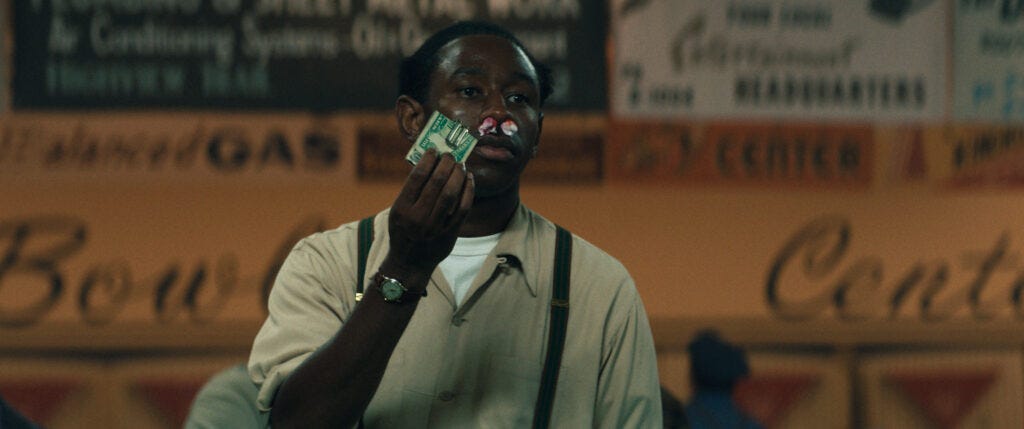
Now, at last, in what is likely a first for Marty Supreme reviews, we arrive at the earth scorching work of Timothee Chalamet. Much has been made about his off screen grandstanding marketing to sell the film, especially as Chalamet all but declares that this performance represents a pinnacle in what is already a storied career. However, it will now be said again that the sheer fury which Chalamet harnesses for this character is not only novel for his filmography thus far, but is indeed one of the finest performances of certainly this year, if not the decade. Chalamet is playing so many different elements at once, always fully grounded in every facet of his body. The journey Marty goes through demands not only a deeply physical performance, one that needs sheer exhaustion to be depicted, but an emotional sky dive as well. In response Chalamet, more than up to the task, and similarities to other Safdie performances aside, fashions something audiences have not quite seen before (except for those moments he’s embodied him on the press tour). 2025 is a year of great lead performances, and while there are many who deserve awards recognition, if it is Timmy’s name called in March, it will not be undeserved.
At this point the technical feats of Marty Supreme, both in this review and in the world at large, are well documented. It is indeed a cinematic wonder, something few likely would dispute, yet what of its theme? Of course, form is theme and the separation of the two is a reductive view. What makes a film itself is inseparable and in fact part and parcel to its message/theming. However, engaging with this question of theme, of what the film is saying, does reveal something profound. Is Marty Supreme truly the inspirational story of resilience stated by its catchy “DREAM BIG” zeppelin? If is not, then by not offering condemnation of Marty’s sins (a classic depiction/endorsement debacle) does that marketing in fact make the film irreparably guilty of tacit toxic endorsement, turning Chalamet’s work into another entry for the cinematic canon of toxic men, wonderfully performed? This certainly is a reading with validity, though only time will tell if Mauser truly becomes an erroneously crowned hero in the vein of Travis Bickle, Jordan Belfort or the Joker. However, placing his name next to those highlights the insufficiency in this consideration, as even if Marty is hardly virtuous, his crimes can hardly be compared to these other men. Thus, while giving due understanding and recognition to this critique, it is a claim which misreads the central conceit, perhaps even provocation, of the film. After all, what about Marty Mauser’s tears?

When Marty returns from Japan and weeps upon seeing the child he had previously so readily denied, not to mention the ways he’d treated Rachel, it is an understandable conclusion to find this an unworthy redemption. Does society really need a film that praises a man who abandons his family in pursuit of some loftier ideal? Yet, this moment of euphoric sadness communicates neither an atonement, nor a justification. It is rather a sincere beat of humanity, especially for a character who maybe does not deserve it. Much because of his own actions, Marty has indeed suffered, consumed by his own capitalistic drive, and despite his final success against Endo, is facing really the obliteration of his goals and the end of his table tennis career. He is frequently sociopathic, constantly brash and arrogant, and hurts the people closest to him in his life, yet, he also weeps, and perhaps, even cares.
These myriad contradictions live in tandem for the film’s final beats, creating a full thesis. Cinema must be afforded a wide berth, and as such it must make room for the sinners, as well as the saints, to have their moments of humanity. Perhaps Marty will inspire more bad behavior the world over or perhaps it is there in that room that Marty realizes a truth for himself, recognizing that maybe the supreme he’d be chasing to such disastrous effect was something different than he expected. Something calmer, something closer to home. Marty Mauser is not a very good person yet it is because of this, not in spite of it, that Marty Supreme is very likely a masterpiece.
*****
Marty Supreme is still in theaters I’m sure.


Comments
Post a Comment